1. The 60-Minute Attack Plan
0–5 min
Read instructions. Scan every section. Start with questions you know.
5–20 min
Grammar, vocabulary, sentence transformation and short language tasks.
20–35 min
Reading/comprehension. Read questions first, then locate evidence in the passage.
35–55 min
Writing. Plan → write → check. Keep sentences simple and accurate.
55–60 min
Check tense, subject–verb agreement, articles, spelling, punctuation and unanswered items.
2. Grammar — Expanded A–Z Revision
This section is deliberately expanded rather than compressed. Read the explanation, study the examples, then try to explain the rule yourself. The Sri Lankan NIE materials explicitly build grammar through accurate communication, sentence relationships, tenses, conditionals, modality, and simple/compound/complex sentence construction. citeturn0search15turn0search16
1. Tenses — The 12 English Tenses Quick Note
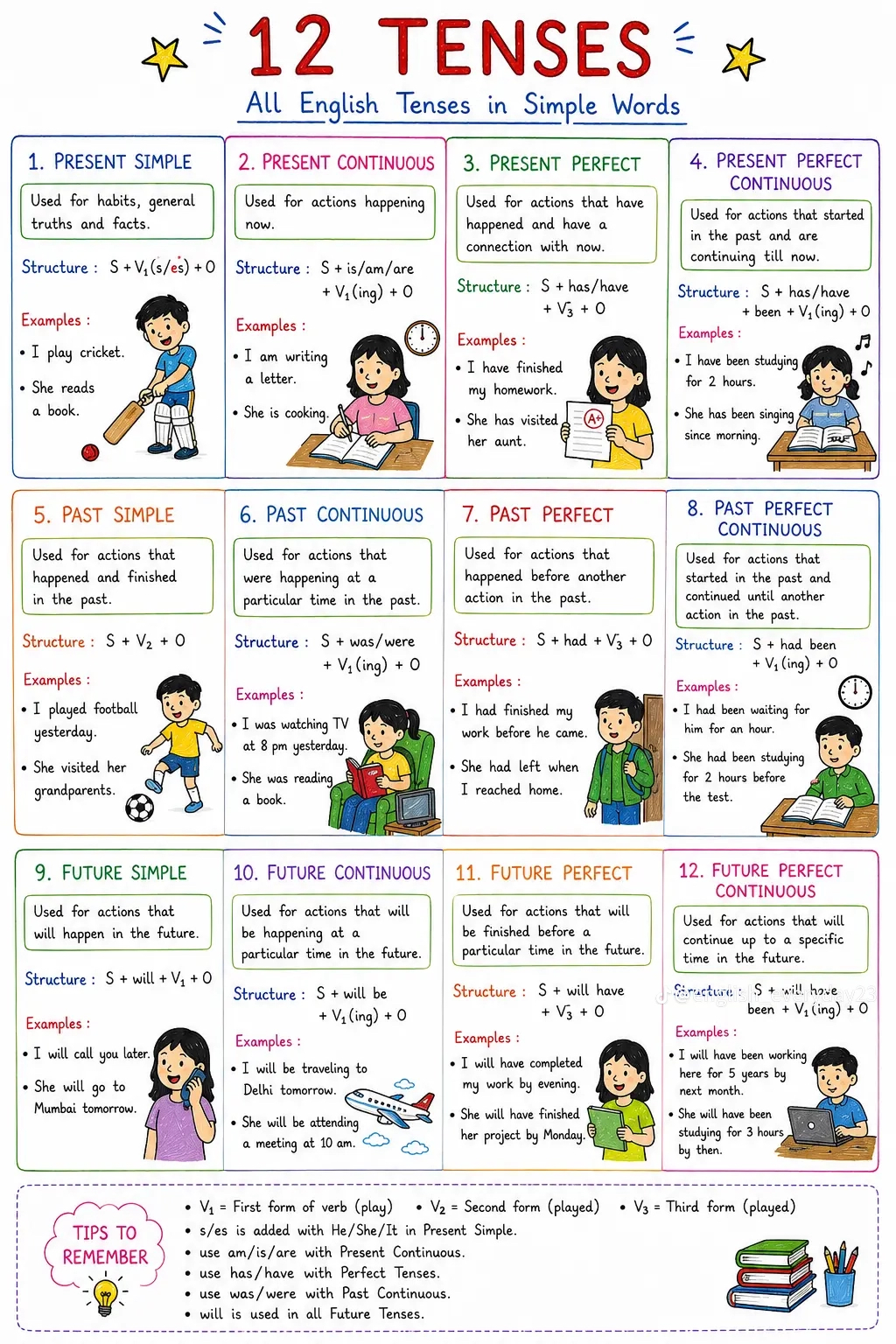
A tense tells us when an action or situation happens. Here is the complete 12 Tenses reference chart based on ss.JPG:
• She reads a book.
• She is cooking.
• She has visited her aunt.
• She has been singing since morning.
• She visited her grandparents.
• She was reading a book.
• She had left when I reached home.
• She had been studying for 2 hours before the test.
• She will go to Mumbai tomorrow.
• She will be attending a meeting at 10 am.
• She will have finished her project by Monday.
• She will have been studying for 3 hours by then.
💡 TIPS TO REMEMBER (From Quick Note Poster)
- V₁ = First form of verb (e.g. play) • V₂ = Second form (e.g. played) • V₃ = Third form (e.g. played / written)
- s/es is added with He / She / It in Present Simple.
- Use am / is / are with Present Continuous.
- Use has / have with Perfect Tenses.
- Use was / were with Past Continuous.
- will is used in all Future Tenses.
🖼️ View Original 12 Tenses Poster (ss.JPG)
How to choose the correct tense
- every day, usually, always, often → usually Present Simple.
- now, at the moment, currently → usually Present Continuous.
- yesterday, last week, in 2020, ago → Past Simple.
- while, at 7 p.m. yesterday → often Past Continuous.
- already, just, yet, ever, never → often Present Perfect.
- since + starting point → since 2020, since Monday.
- for + duration → for two years, for three hours.
- before another past event → often Past Perfect.
2. Passive Voice
In an active sentence, the subject performs the action. In a passive sentence, the focus moves to the person or thing receiving the action.
Passive: The classroom was cleaned by the students.
Basic passive formula: receiver/object + suitable form of be + past participle (V3).
| Tense | Active | Passive |
|---|---|---|
| Present Simple | They clean the room. | The room is cleaned. |
| Past Simple | They cleaned the room. | The room was cleaned. |
| Future | They will clean the room. | The room will be cleaned. |
| Present Continuous | They are cleaning the room. | The room is being cleaned. |
| Past Continuous | They were cleaning the room. | The room was being cleaned. |
| Present Perfect | They have cleaned the room. | The room has been cleaned. |
| Past Perfect | They had cleaned the room. | The room had been cleaned. |
| Modal | They must clean the room. | The room must be cleaned. |
Steps for changing Active → Passive
- Find the object of the active sentence.
- Move it to the beginning.
- Identify the original tense.
- Change be to the correct tense.
- Change the main verb to V3.
- Add by + agent only when the agent is important.
Object = the man → The man was arrested by the police.
Remember: not every verb can be made passive. An intransitive verb without an object generally cannot form a normal passive.
3. Conditionals
Conditional sentences describe a condition and its result. They are especially useful for talking about facts, real possibilities, imaginary situations and unreal past situations.
| Type | Structure | Meaning | Example |
|---|---|---|---|
| Zero | If + Present Simple, Present Simple | General facts, rules and things that are normally true. | If you heat ice, it melts. |
| First | If + Present Simple, will + V1 | Real or possible future condition. | If it rains, we will stay home. |
| Second | If + Past Simple, would + V1 | Unreal, unlikely or imaginary present/future. | If I had more money, I would travel. |
| Third | If + had + V3, would have + V3 | Unreal past; often regret or imagining a different past result. | If I had studied, I would have passed. |
Important conditional rules
- Do not normally put will immediately after if in a normal first conditional: If it rains, I will stay home.
- Unless means if...not: Unless you hurry = If you do not hurry.
- Second conditional commonly uses were for formal/hypothetical situations: If I were you, I would apologise.
- Third conditional looks backwards: had + V3 describes the unreal condition, while would have + V3 describes the imagined result.
4. Modal Verbs
Modal verbs help express ability, possibility, permission, obligation, advice, necessity and polite requests. A modal is normally followed by the base form (V1).
| Modal | Main uses | Example |
|---|---|---|
| can | ability, permission, possibility | I can swim. Can I come in? |
| could | past ability, polite request, possibility | Could you help me? I could swim when I was five. |
| may | permission, possibility | May I leave? It may rain. |
| might | weaker possibility | He might come later. |
| must | strong obligation; strong conclusion | You must wear a helmet. She must be tired. |
| have to | necessity/obligation | I have to finish this today. |
| should | advice, expectation | You should revise tonight. |
| ought to | advice/duty | You ought to respect your parents. |
| would | polite requests, hypothetical situations, repeated past habits in context | Would you like some tea? |
| need to | necessity | You need to practise. |
5. Reported Speech
Direct speech gives the exact words: She said, “I am tired.” Reported speech reports the meaning without quoting the exact words: She said that she was tired.
Common tense changes
| Direct | Reported |
|---|---|
| Present Simple | Past Simple |
| Present Continuous | Past Continuous |
| Present Perfect | Past Perfect |
| Past Simple | Past Perfect |
| will | would |
| can | could |
| may | might |
Time and place changes
today → that day; tomorrow → the next day; yesterday → the previous day; now → then; here → there; this → that; these → those.
Reported statements
Reported: Ravi said that he was busy.
Reported questions
Use statement word order after the reporting verb. Do not keep normal question inversion.
Reported: She asked me where I was going.
Reported: He asked me if/whether I liked tea.
Reported commands and requests
“Please don't be late.” → She asked me not to be late.
6. Relative Clauses
A relative clause gives additional information about a noun. It commonly begins with who, whom, which, that, whose, where or when.
| Word | Use | Example |
|---|---|---|
| who | people | The teacher who helped me was kind. |
| which | things/animals | The book which I bought is interesting. |
| that | people or things in many defining clauses | The phone that I bought is new. |
| whose | possession | The student whose bag was lost is here. |
| where | places | This is the school where I studied. |
| when | time | I remember the day when we met. |
Defining clause: essential information. The student who won the prize is my friend.
Non-defining clause: extra information, normally separated by commas. My brother, who lives in Kandy, is a doctor.
7. Gerunds and Infinitives
A gerund is the -ing form used as a noun or after certain verbs/prepositions. An infinitive is usually to + V1.
Common verbs + Gerund
enjoy, avoid, finish, keep, mind, suggest, practise, consider
She avoided answering.
Common verbs + Infinitive
want, hope, decide, plan, promise, learn, need, agree, refuse
They decided to leave.
After a preposition, use V-ing: She is interested in learning English.
After a modal, use V1 without “to”: She can swim.
Some verbs can change meaning depending on the form: stop smoking = quit the activity; stop to smoke = stop another activity in order to smoke.
8. Linking Words and Conjunctions
Linking words connect ideas and make writing logical. Choose the connector according to the relationship between the ideas.
| Purpose | Useful words | Example |
|---|---|---|
| Addition | and, also, moreover, furthermore, in addition | He is intelligent. Moreover, he is hardworking. |
| Contrast | but, however, although, even though, whereas | Although it was raining, we went out. |
| Reason | because, since, as | We stayed home because it was raining. |
| Result | so, therefore, thus, as a result | It rained heavily; therefore, the match was cancelled. |
| Example | for example, for instance, such as | Many sports, such as cricket, require teamwork. |
| Sequence | firstly, next, then, finally | Firstly, prepare the materials. Then begin. |
| Condition | if, unless, provided that | You can go if you finish your work. |
| Conclusion | in conclusion, to sum up, overall | In conclusion, English is an important skill. |
Important connector differences
- because + clause: We stayed home because it was raining.
- because of + noun/gerund: We stayed home because of the rain.
- although + clause: Although he was tired, he worked.
- despite/in spite of + noun/V-ing: Despite being tired, he worked.
- so + result: It was raining, so we stayed home.
- therefore + result: It was raining; therefore, we stayed home.
9. Advanced Sentence Structures
For O/L English, “advanced” does not mean using extremely difficult vocabulary. It means being able to combine ideas accurately using coordination, subordination, relative clauses, participles and logical connectors. The NIE syllabus materials explicitly include simple, compound and complex sentence construction through coordination and subordination. citeturn0search15
Simple sentence
One independent clause.
Compound sentence
Two independent clauses joined by a coordinating conjunction such as and, but, or, so, yet, nor.
Complex sentence
One independent clause + one or more dependent clauses.
Compound-complex sentence
At least two independent clauses plus at least one dependent clause.
Coordinating conjunctions — FANBOYS
For • And • Nor • But • Or • Yet • So
Correlative conjunctions
either...or, neither...nor, both...and, not only...but also.
She is not only intelligent but also hardworking.
Sentence transformation
You should be able to express the same basic meaning in different structures.
Although → despite: Although he was tired, he continued. → Despite being tired, he continued.
Too...to: The bag is too heavy for me to carry. → The bag is so heavy that I cannot carry it.
Comparison: John is taller than Ravi. → Ravi is not as tall as John.
Participial clauses
These can make writing more natural, but accuracy matters.
Because she was tired, she went to bed. → Being tired, she went to bed.
10. Articles — a, an, the
a and an are indefinite articles. They normally refer to one non-specific countable noun. the is the definite article and usually refers to something specific or already known.
- a university — “university” begins with a consonant sound /y/.
- an hour — the h is silent, so the word begins with a vowel sound.
- the sun — a unique object in the normal context.
- I bought a book. The book is interesting. — first mention becomes specific on second mention.
11. Subject–Verb Agreement
The verb must agree with the subject in number. This is a very common source of avoidable mistakes.
Everyone is ready. / Each student has a book.
Be especially careful with everyone, everybody, someone, nobody, each, every: these normally take singular verbs.
12. Prepositions
| Preposition | Typical use | Example |
|---|---|---|
| at | specific time/point | at 7 p.m., at the station |
| on | days/dates/surfaces | on Monday, on 5 May, on the table |
| in | months/years/long periods/areas | in July, in 2026, in Sri Lanka |
| for | duration | for two years |
| since | starting point | since Monday |
| by | deadline/agent | by Friday; written by him |
| with | instrument/company/association | cut with a knife; with my friend |
13. Word Classes
| Word class | Job | Example |
|---|---|---|
| Noun | person, place, thing, idea | teacher, school, happiness |
| Pronoun | replaces a noun | he, she, they, it |
| Verb | action/state | run, write, be |
| Adjective | describes/modifies a noun | beautiful, difficult |
| Adverb | modifies a verb/adjective/adverb | quickly, very |
| Preposition | shows relationship | in, on, under |
| Conjunction | joins words/clauses | and, but, because |
| Determiner | comes before a noun | a, the, this, many |
14. Question Forms
For many questions, an auxiliary comes before the subject:
She works here. → Does she work here?
They went home. → Did they go home?
After does/did, use the base verb: Does he play?, not “Does he plays?”
15. Question Tags
Question tags are short questions added to the end of statements.
She doesn't drive, does she?
They went home, didn't they?
Positive statement → negative tag. Negative statement → positive tag. Usually use the same auxiliary/modal as the main sentence.
16. Pronouns and Possessives
| Subject | Object | Possessive adjective | Possessive pronoun |
|---|---|---|---|
| I | me | my | mine |
| you | you | your | yours |
| he | him | his | his |
| she | her | her | hers |
| we | us | our | ours |
| they | them | their | theirs |
“It's” = it is / it has. “Its” = possessive form.
17. Comparatives and Superlatives
Use the comparative to compare two things and the superlative to compare one thing with a group.
beautiful → more beautiful → the most beautiful
good → better → the best
bad → worse → the worst
Equal comparison: as + adjective + as → “This book is as interesting as that one.”
18. Common Exam Transformations
- Active ↔ Passive
- Direct ↔ Reported speech
- Simple ↔ Compound ↔ Complex
- because ↔ because of
- although ↔ despite/in spite of
- too...to ↔ so...that
- comparative ↔ “not as...as”
- if...not ↔ unless
19. Grammar Error Checklist
- Is the subject singular or plural?
- Does the verb agree with the subject?
- Is the tense correct for the time expression?
- After a modal, did you use V1?
- After has/have/had, did you use V3?
- After a preposition, did you use a noun or V-ing where appropriate?
- Did you use a/an according to sound?
- Did you choose the correct preposition?
- Did you use the correct pronoun?
- Did you check spelling and punctuation?
3. Vocabulary — High-Yield Revision
Synonyms
big → large/huge; small → tiny; happy → glad/joyful; angry → furious; difficult → hard/challenging; begin → start/commence; end → finish/conclude; help → assist; buy → purchase; ask → inquire.
Antonyms
ancient ↔ modern; accept ↔ reject; increase ↔ decrease; success ↔ failure; temporary ↔ permanent; generous ↔ selfish; polite ↔ rude; possible ↔ impossible; expand ↔ contract.
Prefixes
un-, in-/im-/il-/ir-, dis-, re-, mis-, pre-, post-. Examples: unhappy, impossible, illegal, irregular, disagree, rewrite, misunderstand.
Suffixes
-ness, -ment, -tion, -er/-or, -ful, -less, -ly, -able. Example: happy → happiness; develop → development; educate → education.
Common Confusions
| Pair | Difference |
|---|---|
| advice / advise | advice = noun; advise = verb |
| affect / effect | affect usually verb; effect usually noun |
| accept / except | accept = receive; except = excluding |
| lose / loose | lose = misplace/not win; loose = not tight |
| quiet / quite | quiet = silent; quite = fairly/very |
| than / then | than = comparison; then = time/order |
4. Reading & Comprehension
Fast Method: Q → Scan → Evidence → Answer
- Read the questions first.
- Underline key words mentally.
- Scan the passage for names, dates, repeated words and synonyms.
- Answer from the passage, not from your imagination.
- If asked for a word/phrase, copy accurately.
Question Types
- Who/What/Where/When: locate exact information.
- Why: give the reason stated or clearly implied.
- True/False: compare with the text; do not assume.
- Meaning: use context, not only dictionary memory.
- Inference: combine clues from the passage.
- Best title: choose the main idea, not one small detail.
5. Writing — Templates You Can Reuse
Informal Letter
How are you? I am writing to tell you about [topic]. [Main details in 2–3 short paragraphs.] I hope you can [action].
Write back soon.
Best wishes,
[Name]
Formal Letter
[Date]
The Manager / Principal / Editor
[Organisation]
Dear Sir/Madam,
Subject: [clear topic]
I am writing to [purpose]. [Explain the situation clearly.] I would be grateful if you could [request/action].
Thank you for your consideration.
Yours faithfully,
[Name]
Notice
NOTICE → Event → Date → Time → Venue → Who can participate → Contact/person in charge.
Dialogue
Use natural short turns. Give each speaker a new line. Use appropriate greetings, requests, responses and closing.
Paragraph / Essay
Introduction: introduce topic. Body: 2–3 main points + examples. Conclusion: final opinion/summary.
Picture / Situation Description
Start with the overall scene, then describe people/actions/objects, then conclude with the likely situation. Use present continuous for visible actions: A boy is riding a bicycle.
Useful Connectors
Firstly • Secondly • Moreover • In addition • However • On the other hand • Therefore • As a result • For example • Finally • In conclusion.
6. Functional English
| Function | Useful language |
|---|---|
| Greeting | Hello! / Good morning. / Nice to meet you. |
| Request | Could you please...? / Would you mind...? |
| Permission | May I...? / Can I...? |
| Advice | You should... / You ought to... / If I were you... |
| Suggestion | Let's... / Why don't we...? / How about + V-ing? |
| Offering | Would you like...? / Shall I...? |
| Agreeing | I agree. / That's a good idea. |
| Disagreeing | I don't think so. / I see your point, but... |
| Apology | I'm sorry. / I apologise for... |
| Thanking | Thank you very much. / I really appreciate it. |
| Invitation | Would you like to come to...? / I'd like to invite you to... |
| Directions | Go straight. / Turn left/right. / It is next to/opposite... |
7. Spelling & Punctuation
Common spellings
necessary, separate, beautiful, government, environment, development, opportunity, experience, successful, different, accommodation, beginning, receive, believe.
Remember
i before e is useful but has exceptions. Learn common exam words individually. Double consonants often appear before -ing/-ed: run → running, stop → stopped.
Punctuation
Full stop . • comma , • question mark ? • exclamation mark ! • apostrophe ' • quotation marks " " • colon : • semicolon ;.
Capital letters: sentence beginnings, names, countries, languages, days, months, titles where appropriate.
8. Literary Basics
The Sri Lankan NIE curriculum includes English literary texts as a separate component alongside English Language. For a language-focused 1-hour revision, know the basic terminology below.
| Term | Meaning |
|---|---|
| Theme | Main idea/message explored by a text. |
| Plot | Sequence of events in a story. |
| Character | Person/figure in a literary work. |
| Setting | Time and place of a story. |
| Simile | Comparison using like/as. |
| Metaphor | Direct comparison without like/as. |
| Personification | Giving human qualities to non-human things. |
| Alliteration | Repetition of initial consonant sounds. |
| Imagery | Language creating sensory pictures. |
| Irony | Contrast between expectation and reality. |
| Stanza | Group of lines in a poem. |
| Rhyme | Similarity of ending sounds. |
9. Quick Self-Test
10. 60-Minute Mini Mock
Use the timer above. Try this without looking at the revision notes.
11. Final 5-Minute Checklist
- ☐ I know the 7 main tenses and their basic forms.
- ☐ I can identify nouns, verbs, adjectives and adverbs.
- ☐ I know articles: a/an/the.
- ☐ I can use prepositions of time/place.
- ☐ I can handle active/passive voice.
- ☐ I can handle direct/indirect speech.
- ☐ I know conditional sentences.
- ☐ I can form questions and question tags.
- ☐ I can use common linking words.
- ☐ I know common synonyms, antonyms and confusing words.
- ☐ I can write a basic formal/informal letter, notice and paragraph.
- ☐ I can answer comprehension questions using evidence from the passage.